
Decoration guide
Puff Print vs Embroidery for Custom Streetwear
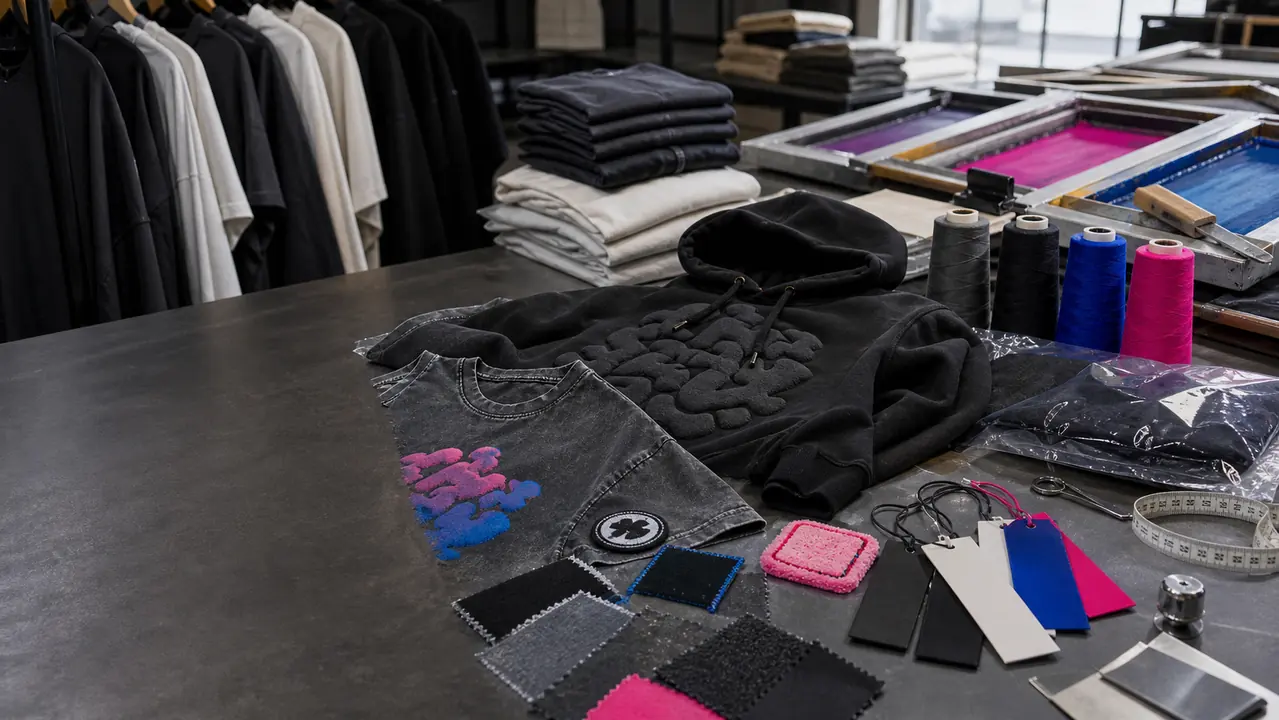
Puff print and embroidery create different texture, cost, placement, and durability results. Choose the method based on artwork size, garment fabric, brand positioning, and order quantity.
Raised graphic effect.
Premium stitched finish.
Small-batch decoration review.
Brand buyer support.
Buyer decision
When puff print works best
Raised logos
Puff print works well for bold text, simple graphics, chest marks, sleeve hits, and back prints.
Streetwear texture
It creates a raised surface that fits hoodie and T-shirt graphics when artwork is not too detailed.
Cost control
For larger graphic areas, puff print can be more practical than dense embroidery.
Buyer decision
When embroidery works best
Premium details
Embroidery is strong for chest logos, neck marks, woven-style badges, and small brand details.
Durability
Durability depends on fabric, artwork, execution and care. A premium stitched appearance is not proof of a longer service life.
Detail limits
Very small text, gradients, and large dense fill areas need review before embroidery approval.
RFQ preparation
Decoration details to send before sampling
- Artwork file or clear reference image.
- Garment type, fabric, GSM, and placement area.
- Target quantity and size range.
- Preferred effect: raised graphic, stitched logo, reflective effect, or mixed method.
- Private label packaging and shipping country if the decoration is part of a full production order.
FAQ
Puff print and embroidery buyer answers
Is puff print better than embroidery for hoodies?
Neither method is always better. Puff print works well for raised graphics, while embroidery works well for premium stitched logos and smaller brand marks.
Can one streetwear product use both puff print and embroidery?
Yes. A hoodie or T-shirt can combine methods if artwork placement, fabric, MOQ, and production cost are suitable.
What files are needed for print or embroidery review?
Send artwork, placement size, garment type, fabric or GSM, quantity, and reference images so MyOwnWear can review the production route.
Next step
Send the artwork, garment reference, quantity, and target handfeel.
MyOwnWear will review artwork scale, fabric/GSM, craft method, MOQ, labels, packaging, and placement.
Decoration decision guide
Choose the process from the artwork, garment and approval risk.
Puff print is usually the stronger route for bold raised graphics. Embroidery is usually the stronger route for compact stitched marks. A mixed route can combine both, but it adds another approval point. The right choice depends on artwork scale, fabric stability, placement, quantity and the result the sample must prove.
Buyer guidance reviewed Oct 18, 2026
| Decision point | Puff print | Embroidery | Mixed route |
|---|---|---|---|
| Best visual job | Raised chest, back or sleeve graphics with clear shapes. | Compact logos, tonal marks, badges and stitched identity details. | A hero graphic plus a smaller premium brand detail. |
| Artwork fit | Simple silhouettes and controlled line thickness; tiny text and fine gaps need review. | Shapes that translate into stitch paths; gradients, very small text and dense fills need review. | Separate artwork files, dimensions, colors and placements for each process. |
| Garment check | Fabric surface, GSM, stretch, seams and wash sequence affect the raised result. | Fabric stability, backing, stitch density and placement affect puckering and weight. | The garment must support both processes without crowding seams, pockets or each other. |
| What the sample must prove | Height, edge control, handfeel, placement and appearance after the planned finish. | Thread color, coverage, edge quality, backing, distortion and placement. | Each effect separately, then the balance and production sequence together. |
| Main quote variables | Print size, color count, setup, garment quantity and any wash or special-finish sequence. | Finished size, stitch coverage, thread colors, backing, placement and quantity. | Both setup routes, extra handling, sample scope and the number of approvals. |
| Before bulk approval | Approve the intended garment and effect, not only a loose print test. | Approve the stitched result on the intended fabric and placement. | Approve one complete garment showing both processes in final positions. |
Quick production answers
- When should a streetwear brand choose puff print?
- Puff print is usually stronger for bold raised graphics, chest marks, sleeve graphics and simple artwork shapes that can hold a raised edge.
- When should a streetwear brand choose embroidery?
- Choose embroidery for stitched brand marks, small logos, tonal details and patch-style identity. Confirm artwork suitability and sample performance; a premium finish alone does not establish durability.
- What details should be sent for a puff print or embroidery RFQ?
- Send the garment type, fabric or GSM target, artwork file, finished logo size, placement, color count, desired handfeel, quantity, labels, packaging and whether the brief uses puff print, embroidery or both.
- How do we compare durability before bulk approval?
- Compare samples on the intended fabric and finish, at comparable finished sizes and placements, under the same agreed care conditions. Record process-specific adaptations and agree acceptable appearance and comfort changes before checking. If both meet the brief, choose by look, handfeel and budget. If only one meets it, approve only for those recorded conditions. If neither meets it, revise and resample. Missing or non-comparable evidence means durability is not established, not an automatic failure. Passing the same check does not establish equal lifespan. Recheck if fabric, finish, artwork or care conditions change.