
Brand Buying · Production insight
How to Vet a Streetwear Manufacturer Before Paying for a Sample
Before paying for a streetwear sample, verify three things: the supplier can be identified, the supplier has understood the same product you want developed, and the payment, evidence, and approval path are clear in writing. A polished catalog or fast quote is only a starting signal. Ask focused questions, request evidence that matches your order, record what remains unverified, and pay only after the sample scope and commercial terms are reviewable.
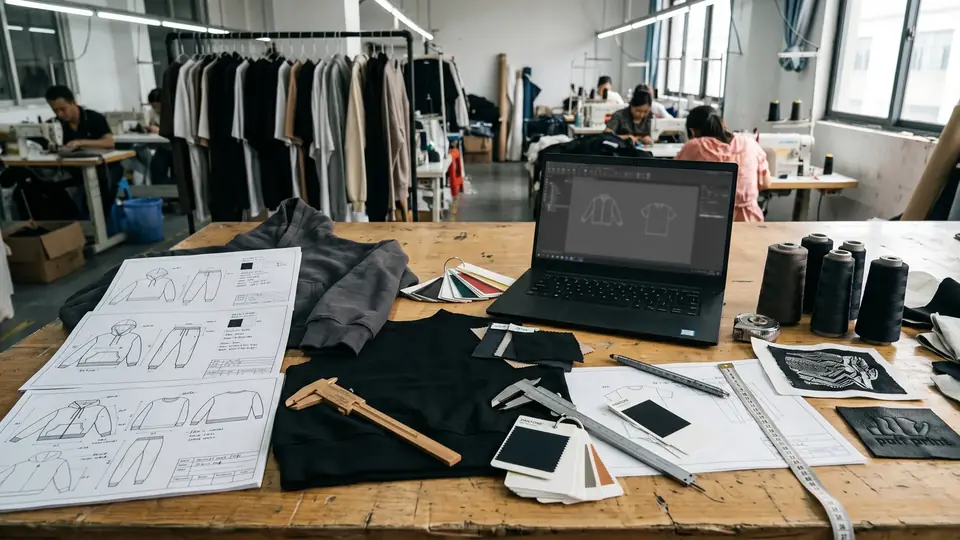
This article is for a buyer who has found a possible manufacturer and is deciding whether the next step should be a paid development sample. It is not a factory-ranking article, a certification directory, or a promise that any single check can predict production quality. The goal is narrower: make the decision to pay for development more informed and more reversible.
Vet the Supplier in Layers, Not With One “Trust” Check
Supplier vetting is stronger when several independent signals agree. A website, marketplace profile, video call, invoice, sample photo, and company document may all come from the same source, so they are not automatically independent evidence. Treat each item as one input and ask what it actually proves.
Use this five-layer framework before approving a sample payment:
| Layer | What you are testing | Evidence to request or record | What it does not prove |
|---|---|---|---|
| Identity | Can you identify the contracting party? | Legal or trading name, business address, named contact, invoice details, and payment-account name | That the supplier will deliver acceptable goods |
| Product fit | Did the supplier understand your actual product? | A written brief recap, questions about fit/material/craft, and an itemized sample scope | That the proposed construction will work until developed and reviewed |
| Process | Is there a traceable path from brief to approval? | Revision rules, approval checkpoints, file/version handling, and escalation contact | That every promised checkpoint will be performed well |
| Evidence | Can important claims be checked against the order? | Dated, relevant photos, videos, documents, or references that can be reasonably verified | That old or generic evidence represents your product |
| Commercial control | Can the payment and next decision be understood? | Pro forma invoice, currency, inclusions, exclusions, payment terms, refund/credit language, and sample dispatch terms | That a low sample fee means low total project risk |
Do not turn this into a superficial scorecard where five boxes checked equals “safe.” A missing identity detail, a mismatched payment account, or an unanswerable product question can matter more than several attractive portfolio images.
1. Confirm Who Would Receive the Payment
Start with the transaction, not the supplier’s social feed. Ask for the information that will appear on the commercial documents:
- the legal or trading name of the party issuing the invoice;
- the operating or registered address, where relevant to the transaction;
- the name and role of your day-to-day contact;
- the email domain and other contact channels used for the order;
- the name and location of the party receiving payment;
- the currency, payment method, and any intermediary or platform involved;
- the entity that would be responsible for the sample and any later order.
The names do not always have to be identical. A manufacturer may use a trading name, sales company, sourcing partner, or payment processor. The important point is that the relationship is explained before money moves. Ask the supplier to state which entity is contracting with you and why the payment recipient differs, if it does. Keep the answer with the quote and invoice.
Use the About page as an example of the type of company-context page a buyer can review: it helps establish what a supplier says about its focus and route to contact. It is context, not independent proof. For any supplier, compare the public description with the name and terms on the actual transaction documents.
Pause when the payment trail changes without explanation
Treat these as clarification points before payment:
- the invoice name, contract name, and payment-account name do not align;
- payment is requested to a personal account or an unrelated country without a written explanation;
- the supplier changes bank details through an unexpected channel;
- the invoice omits the product, sample scope, currency, or supplier identity;
- a person who was not involved in the quotation suddenly becomes the payee.
These signals do not establish wrongdoing by themselves. They do establish that the transaction is not yet sufficiently documented. Verify a changed payment instruction through a known channel, and do not let urgency replace confirmation.
2. Test Whether the Supplier Understands the Product
A supplier can be genuine and still be a poor fit for a specific streetwear project. Before paying for a sample, send a concise, versioned brief and observe the quality of the questions that come back.
The brief can identify:
- product type and intended silhouette;
- reference measurements or a tech pack, if available;
- fabric direction, composition, finish, and target GSM;
- size range and sample size;
- decoration method, artwork dimensions, placement, and file version;
- trims, labels, packaging, and any special construction;
- destination and the purpose of the sample;
- what you need the sample to confirm before a bulk decision.
You are not testing whether the supplier repeats every word. You are testing whether it notices decisions that affect development. A useful response may ask about a measurement, flag an artwork limitation, separate a visual prototype from a bulk-representative sample, or identify a trim that needs confirmation. A generic “yes, can do” leaves more risk unresolved.
Ask the supplier to summarize its understanding in writing. Compare the summary with your brief line by line. If the supplier has changed the fabric, decoration, fit, or label scope to reach a target price, that is a different proposal and should be named as such.
For the supplier’s broader production route and handoff expectations, review the Services page. The page can help a buyer understand how a manufacturer describes its design-to-production support. It should not be treated as proof that a proposed supplier can execute every construction, craft, quantity, or destination requirement; those points still need project-specific confirmation.
3. Define What the Paid Sample Will Prove
“Sample” is not a single, universal deliverable. Before paying, name the sample’s purpose and boundaries. Is it primarily for checking silhouette? Is it meant to test a fabric and decoration combination? Does it include labels or packaging? Which details may remain provisional?
Put the answer in the quote or pro forma invoice. At minimum, confirm:
- Sample identity: product name, style reference, color, size, and brief/version.
- Materials: fabric, trims, thread, print or embroidery route, and any approved substitute.
- Included development: pattern work, artwork adaptation, decoration setup, labels, packaging, and finishing.
- Review point: what the buyer is expected to inspect when the sample arrives.
- Revision rule: what happens if a change is needed and which changes create a new charge.
- Dispatch terms: sample shipping cost, destination basis, tracking responsibility, and any taxes or duties outside the sample fee.
- Bulk handoff: what written approval or revised specification would be used if the project proceeds.
The custom streetwear sample process is the relevant Resource for understanding common approval questions and what sampling can confirm. This article has a different job: it helps you decide whether the supplier’s proposed sample is defined well enough to fund. Do not assume that following a resource checklist makes an unverified supplier suitable.
Separate “included” from “promised later”
Ask the supplier to label each item as one of four states:
- Included in this sample
- Included in a later stage
- Available at an additional cost
- Not yet confirmed
This simple distinction prevents a common misunderstanding: a buyer sees a finished reference photo and assumes every visible detail is part of the paid sample. A reference image shows an outcome; it does not define the scope of your order.
4. Request Evidence That Matches the Claim
Evidence is useful only when it is relevant, attributable, and specific enough to test. Ask for the smallest set of evidence needed for the decision instead of collecting a large folder of generic images.
| Supplier statement | Better follow-up | Evidence boundary |
|---|---|---|
| “We make this style.” | Which construction details in my brief are included in the proposed sample? | A similar photo does not prove the same pattern, fabric, or finish. |
| “We can do this decoration.” | What method, dimensions, file preparation, and approval step are proposed for this artwork? | A logo photo does not prove the same artwork will reproduce at the requested size. |
| “We have quality control.” | Which checks apply to this product, against which approved reference, and when? | The phrase alone does not define a control plan. |
| “We have worked with many brands.” | Can you provide a reference that you are permitted to share and that is relevant to this type of work? | Do not treat a logo list or testimonial image as verified customer evidence. |
| “We are certified.” | What certification, legal entity, scope, issuer, and validity details can be checked? | Never record a certification as fact without current, attributable evidence. |
Possible evidence formats include a dated video call, a live walkthrough of relevant work, a close-up of a comparable construction, a written process document, a business document, or a reference contact shared with permission. The right format depends on the claim. A video can show current access to a workspace, but it may not prove ownership, capacity, compliance, or future performance.
Use live evidence carefully
If you request a live walkthrough, ask the supplier to show only what is relevant to your decision: a comparable garment, a decoration test, a measurement reference, a sample record, or the process used to identify revisions. Note the date, participants, and what was actually shown. Do not describe a visual impression as a verified fact.
If a supplier cannot share a client name, factory address, or document for confidentiality reasons, that may be understandable. Ask whether an alternative form of evidence can support the narrower claim. If no evidence can be shared, record the claim as unverified and reduce the amount of risk you are willing to take at this stage.
5. Review the Payment and Communication Controls
Before paying a sample fee, make sure the commercial path is as clear as the product path. Your record should answer:
- Who issued the invoice?
- What exactly is being paid for?
- What is the total amount and currency?
- Which bank, platform, or payment account receives the funds?
- Are sample shipping, revisions, artwork setup, taxes, duties, and other charges included or excluded?
- Sample lead time: What is the stated lead time, which written event starts it, what review or revision assumptions can move it, and when is the sample considered ready for dispatch?
- How will progress, questions, and approvals be recorded?
- What happens if the sample cannot be made as described?
- Is any credit toward a later order offered, and under what written condition?
Do not assume that a sample fee is refundable, transferable, or creditable unless the supplier states the condition in writing. Do not assume that a platform’s payment protection covers every dispute or every transaction type; read the terms that apply to the payment method and destination.
Keep communication in a thread or system that preserves attachments, dates, and versions. If a key decision is made on a call or in a disappearing message, restate it in the order record and ask the supplier to confirm. The objective is not paperwork for its own sake. It is a shared reference when the physical sample differs from the agreed scope.
6. Set Evidence and Risk Boundaries Before You Decide
A responsible vetting decision names what is known, what is plausible, and what is still unknown. Use three columns in your buyer record:
| Status | Examples | Decision treatment |
|---|---|---|
| Verified for this decision | The supplier identity on the invoice matches the confirmed payee; the sample scope is written and acknowledged | Use it as a basis for the next step, without treating it as a production guarantee |
| Plausible but not independently confirmed | A portfolio image resembles the requested garment; a contact describes a claimed facility | Ask a narrower question or request relevant evidence |
| Unknown or inconsistent | No clear contracting entity; payment instructions conflict; key product details are missing | Pause, correct the record, or choose not to proceed |
“Verified” should be qualified: verified for what, when, and from which evidence? A document may confirm a company name but not workmanship. A video call may confirm that a person can show a sample but not that bulk orders will be made in the same place. A sample may reveal the development result but not guarantee repeat consistency.
Avoid two opposite errors:
- Over-trust: treating a badge, follower count, factory photo, or confident promise as proof of every capability.
- Over-rejection: treating one missing item as conclusive when a reasonable alternative can answer the same question.
The right boundary is proportional to the decision. Before a small development payment, verify the transaction, scope, contact path, and evidence needed to understand the sample. Before a bulk commitment, repeat due diligence at the level required by the order, contract, destination, and operational risk.
Red Flags That Should Stop the Payment Until Clarified
Pause rather than pay when:
- the supplier refuses to identify the contracting party or explain the payment recipient;
- the invoice does not identify the product, sample scope, amount, or currency;
- the supplier will not acknowledge the brief or keeps changing important specifications verbally;
- the proposed sample cannot demonstrate the decision you need to make;
- a price or deadline is presented as fixed while key materials, artwork, or shipping details remain unknown;
- evidence is generic, copied, undated, or unrelated to the claim being made;
- the supplier pressures you to pay immediately because the terms are “about to expire” without a usable written quote;
- communication moves to a new channel and payment instructions change without independent confirmation.
A red flag is not a verdict about the entire business. It is a signal to stop the current transaction until the specific gap is resolved. If the answer is clear and documented, update the risk record. If the answer stays evasive or contradictory, do not pay merely to obtain information that should have been available before payment.
A Short Pre-Payment Decision Sheet
Complete this sheet in the buyer’s own records:
| Question | Yes / No / Open | Evidence or next action |
|---|---|---|
| Do I know which entity will contract, invoice, and receive payment? | ||
| Does the supplier’s written brief recap match my current product version? | ||
| Is the sample’s purpose and included scope specific enough to review? | ||
| Are revisions, extra charges, shipping, and approval terms written? | ||
| Is the sample lead time tied to a written start trigger, review and revision assumptions, a dispatch point, and a progress-update route? | ||
| Does each important capability claim have relevant evidence or a clear limitation? | ||
| Can I verify payment instructions through a known contact path? | ||
| Have I recorded what the sample will not prove about bulk production? | ||
| Is the remaining uncertainty acceptable for this payment, or should I pause? |
If an answer is “Open,” write the question you will ask and the evidence that would close it. “I have a good feeling” is not a recorded control. Neither is “the supplier has a lot of photos.” A decision sheet makes the gap visible without pretending to produce certainty.
Buyer answers
Frequently Asked Questions
Should I ask for a factory video before paying for a sample?
You can ask for a relevant walkthrough, but a video is one piece of evidence rather than a guarantee. Record what was shown, when it was shown, and which claim it supports. If the supplier cannot share a walkthrough, ask for another form of evidence that addresses the same question.
Is a business license or certificate enough to vet a manufacturer?
No. A document may help identify an entity or support a specific claim, but it does not by itself prove product fit, workmanship, current operating status, or future delivery. Check the document’s issuer, scope, entity, and date where those details matter, and keep the claim limited to what the document actually supports.
What should a sample invoice include?
It should identify the contracting or invoicing party, product and version, sample purpose, materials and decoration included, total amount, currency, payment recipient, shipping basis, revision or extra-charge terms, and any exclusions that could change the next decision. The exact terms depend on the transaction, so ask the supplier to resolve open fields in writing.
Can one approved sample prove that bulk production will be consistent?
No. A sample can provide evidence about the developed item and help establish an approved reference. It cannot, by itself, prove that every bulk unit will match, that materials will remain available, or that all later process controls are suitable. Those expectations need an agreed specification, approval record, and appropriate quality-control plan.
What if the manufacturer cannot provide customer references?
Do not invent confidence to fill the gap. Ask whether the supplier can provide anonymized or permission-based evidence relevant to your product, or offer a narrower verification step. Record the reference claim as unverified and decide whether the remaining uncertainty is acceptable before paying.
Choose a Reviewable Next Step
When identity, product understanding, sample scope, evidence boundaries, and payment terms are clear, you can make a more deliberate sample decision. If important answers remain open, pause and ask for a revised written record instead of paying to discover the scope afterward.
If you want a supplier to review a defined streetwear brief, send the RFQ through the contact form. Include the product reference, measurements or tech pack, material direction, artwork, quantity, destination, sample objective, and the questions that still need an answer. Feasibility, sample scope, and any later production decision depend on the information supplied and must be confirmed for the specific project.