
Production Planning · Buyer guide
How to Build a Streetwear Production Timeline Backward From Your Target Date
Build the plan backward from the date approved inventory must be available. Then map brief freeze, quote review, sample development, sample approval, bulk production, QC, packing, shipping, and receiving. Every date needs an owner, dependency, and acceptance condition.
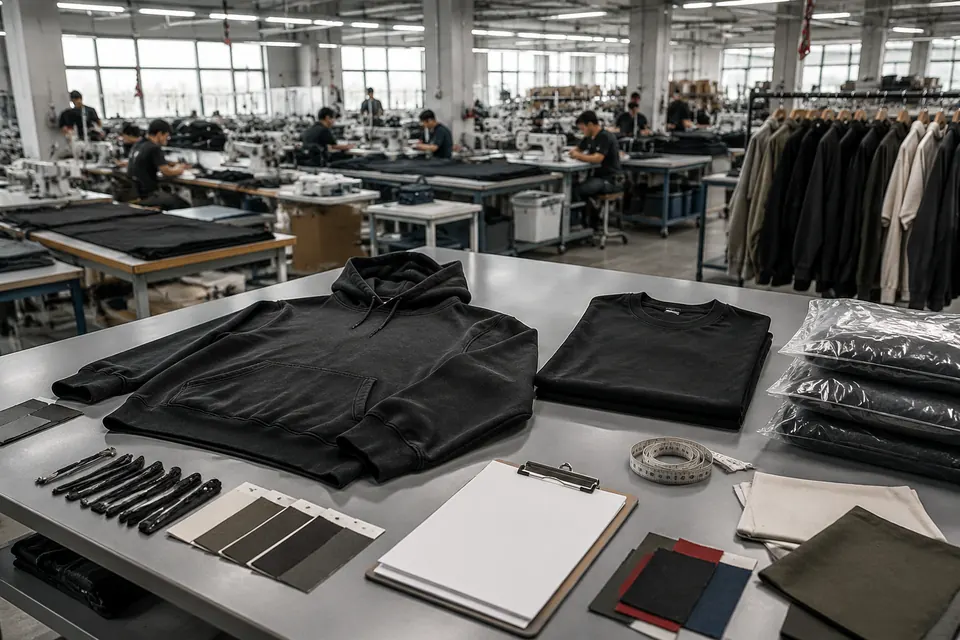
This guide is for a streetwear brand that has a campaign, retail, photo-shoot, or stock-ready date but does not yet have a supplier-confirmed production plan. Start with the date the approved goods must be available at the named destination. A public launch date may happen earlier, so record both dates rather than treating them as the same milestone.
The sequence below is a planning framework, not a universal delivery promise. Product type, quantity, size mix, fabric, decoration, packaging, approval speed, shipping route, and destination tasks all affect the actual project. For the fields that belong in the first supplier brief, use the quote-ready streetwear RFQ checklist.
Start With the Stock-Ready Date
Write the endpoint in one sentence:
Stock-ready date: the date by which the approved quantity, size mix, packaging, and receiving plan must be available at the named destination.
Then add any earlier dates that create a dependency: a campaign shoot, a retail appointment, a warehouse booking, a creator seeding window, or a public launch. This separates the production endpoint from the marketing calendar and makes it easier to see where a missed approval would affect the business.
List the Milestones Before Guessing the Gaps
A useful schedule names what must be decided at each gate. Do not begin with a single number such as “four weeks production” and fill in the details later.
| Gate | What must be decided or checked | Evidence to keep |
|---|---|---|
| Target date | Stock-ready date, destination, campaign and receiving dependencies | Dated project brief |
| Brief freeze | Product rows, quantity by color and size, fit, material, decoration, labels, and packaging | Versioned RFQ |
| Supplier review | Scope, assumptions, exclusions, sample route, and commercial basis | Written quote and questions |
| Sample development | What the sample is intended to prove and which route it represents | Sample request and reference files |
| Feedback and approval | Prioritized revision decision and remaining open points | Marked feedback and approval record |
| Bulk production | Approved reference, quantity, material, decoration sequence, and handoff | Production confirmation |
| QC and packout | Measurements, workmanship, decoration, labels, sorting, bags, and cartons | Inspection or handoff record |
| Shipping and receiving | Named handoff point, freight route, import tasks, and receiving checks | Shipment and receiving records |
Some projects combine gates. Others need an extra proof for a wash, embroidery, applique, puff print, trim, or packaging route. The key is to state the decision each gate must settle before a date is treated as reliable.
Freeze the Product Brief Before the Final Quote
A target date cannot compensate for an unstable product brief. Before comparing final prices or dates, separate each style into a product row and record the current status of every major variable:
- garment type, reference, intended fit, and sample size;
- quantity by color and size;
- fabric direction, composition, finish, and target GSM where relevant;
- decoration method, artwork version, finished size, and placement;
- neck labels, care labels, hangtags, polybags, stickers, and carton marks;
- destination, shipping basis, stock-ready date, and sample objective.
Mark each field as confirmed, open, or deferred. A moodboard is not a confirmed production specification. A missing fabric finish, decoration size, size ratio, or packaging rule can change the quote and the work required after approval.
When a capsule includes several styles, use the first-capsule planning guide to separate shared variables from experiments. That keeps one new wash or construction detail from silently changing the whole schedule.
Put Supplier Review and Sample Approval on the Critical Path
Supplier selection and sample approval are decision gates, not administrative pauses. Ask each candidate to identify which product and measurement references were used, what fabric and decoration route the sample represents, what the sample is intended to prove, and which approval releases the next step.
Useful sample questions include:
- Which fit, fabric, trims, and decoration are represented in this sample?
- Which files or approvals are required before development begins?
- Which changes would require a new sample or revised quote?
- What must be approved before bulk production is released?
Keep the sample schedule separate from bulk production. A sample may prove fit and appearance without proving every bulk outcome. The custom streetwear sample process covers fit, fabric, decoration, labels, packaging, and approval checkpoints in more detail.
Make Feedback a Dated Decision
Sample feedback can move a timeline when it is incomplete, contradictory, or changes several independent variables at once. Set a review owner and response date for each sample. Group comments that belong to one decision, and separate fit, material, decoration, and packaging changes when combining them would make the next sample difficult to interpret.
A short approval record should contain:
- Sample identity and version.
- Approved points.
- Required changes in priority order.
- Open questions and the owner of each answer.
- Evidence required for the next review.
- The date when the decision is due.
The sample revision feedback guide explains how to turn vague comments into a usable next action. This article adds the scheduling rule: do not place the next milestone on the calendar until its acceptance condition is clear.
Separate Bulk Production, QC, Packing, and Shipping
“Production complete” is not always the same as “stock ready.” Bulk production may be followed by quality review, rework decisions, folding, bagging, carton reconciliation, export handoff, freight movement, destination handling, and receiving inspection.
Ask the supplier where each milestone starts and stops:
- When is bulk considered ready for the agreed QC or handoff?
- Which approved reference controls measurements, workmanship, decoration, and labels?
- Is packout by size, color, SKU, or set part of the agreed scope?
- What carton information will be available for receiving?
- Which shipping basis and named place are used for the answer?
- Which export, import, duty, tax, brokerage, or final-delivery tasks remain outside the quoted route?
Use the custom clothing quality control checklist to define the checks that matter for the order. For US or Europe destinations, treat import and receiving responsibilities as project-specific questions instead of assuming one route applies to every buyer.
Add Buffers Around Decisions, Not Only Production
A buffer is useful only when its purpose is visible. Identify the uncertainty it is meant to absorb:
- buyer review or approval availability;
- artwork adaptation or decoration proof;
- material confirmation or color development;
- a sample revision;
- QC findings and a recheck;
- freight or receiving coordination;
- destination-dependent import handling.
The size of each buffer depends on the actual project and the parties responsible for each decision. A supplier-confirmed milestone is more useful than a generic industry promise, but it still needs the underlying specification and a written record of what would move it.
What Can Force the Timeline to Be Rebuilt?
Revisit the plan after a material fact changes. Common triggers include a new fit block or size range, a quantity mix change, a different fabric or wash, new artwork dimensions, a new decoration sequence, an added label or packaging component, a revised sample acceptance rule, or a different destination.
Record the change, its owner, and the milestone it affects. Do not silently keep the old target date after changing the product that date was based on.
Turn the Timeline Into a Reviewable RFQ
Once the milestones are listed, send the supplier a concise scheduling section with the production brief. Ask for:
- the earliest milestone that can be confirmed from the submitted scope;
- the event that starts each later milestone;
- the buyer approval required at each gate;
- the assumptions that could change the sequence;
- the latest decision date that protects the stock-ready date, if it can be calculated for the project;
- the shipping basis, destination, and receiving handoff used for the answer.
Do not ask for a fixed delivery promise before the product, quantity, decoration, packaging, destination, and approval responsibilities are understood. A conditional milestone with its assumption stated is more useful than a confident date built on missing scope.
Buyer answers
Streetwear Production Timeline Questions
Is there a standard streetwear production timeline?
There is no universal timeline for every product. The sequence and dates depend on the submitted specification, quantity, material and decoration route, sample approvals, packaging, destination, and supplier-confirmed milestones.
When should I ask a manufacturer for a delivery date?
Ask for a project-specific milestone review after the product brief, quantity, decoration, packaging, destination, and approval responsibilities are visible. Before that point, request the missing assumptions instead of treating a broad estimate as a final commitment.
Should sampling and bulk production be planned as one step?
No. Sampling should have a defined purpose and approval gate before bulk production is released. A sample may confirm some fit, material, decoration, label, or packaging questions without proving every bulk outcome.
How much buffer should a US or Europe buyer add?
There is no fixed buffer that fits every destination. Separate buyer approvals, production and QC decisions, shipping movement, receiving coordination, and destination-specific import tasks, then ask the relevant supplier and logistics partners to confirm the assumptions.
What should I send with a timeline-ready RFQ?
Send the product rows, quantity by color and size, fit and material direction, decoration and artwork details, labels and packaging, destination, target stock-ready date, sample objective, and the decisions that are still open. When the brief is ready, send the production brief through the RFQ form.
Make the Date Traceable
A strong launch timeline is not a generic promise printed beside a product list. It is a chain of decisions: a defined brief, supplier review, a sample with a clear purpose, recorded feedback, an approved reference, bulk and QC gates, and a named shipping and receiving handoff.
Before the first supplier call, review the quote-ready RFQ checklist and the streetwear manufacturing quote comparison guide. When the scope is ready for a project review, send a timeline-ready production RFQ.